
Independent AI safety & open research
Look inside.
Test the explanation.
How does a model learn a pattern? What makes it refuse? And when it appears to forget, what have we actually measured?
Mechanistic interpretability
From observing behaviour
to testing its cause.
My open research programme follows a practical sequence: observe a behaviour, locate the components associated with it, and intervene to test the explanation.
The repository documents 25 experiments, from induction circuits and self-repair to refusal, unlearning, sparse autoencoders, and attribution graphs. The notes include controls, limitations, and corrections as the evidence changes.
Start with the intuition
The experiments, made explorable.
Move through training checkpoints, compare circuit interventions, and explore the research through interactive explanations drawn from the repository’s result data. Runs in your browser.
Questions behind the work
Follow the evidence.
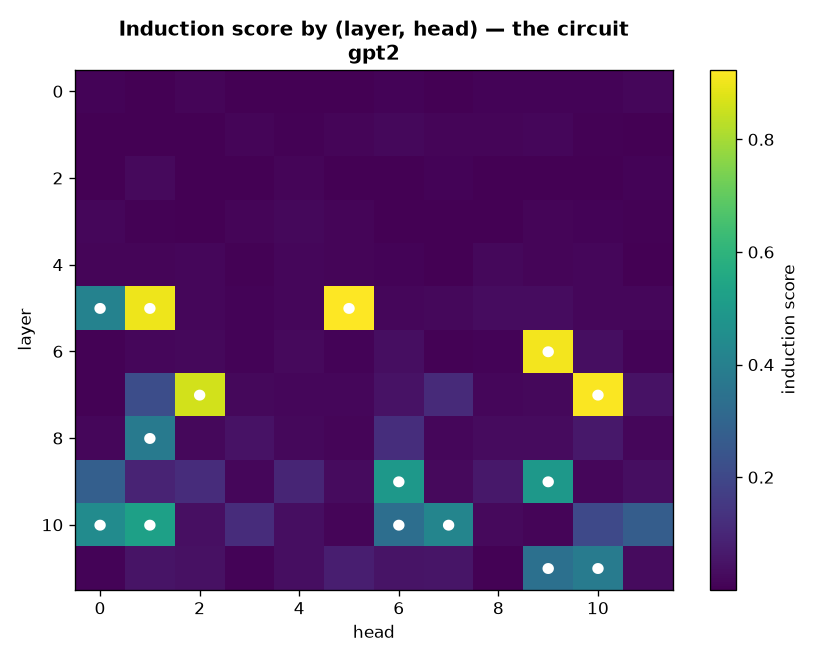
Induction circuits, controls & self-repair
Where does in-context learning happen?
Locate the attention heads involved in recognising repeated patterns, then intervene to test their role. Compare architectures and examine how backup pathways respond when a circuit is disrupted.
Read the experimentRefusal, unlearning & evaluation
Did the model forget, or just stop answering?
Compare generation and probability-based evaluations of unlearned models. Test whether a model’s apparent forgetting changes with the measurement, using reference checkpoints to separate suppressed answers from absent knowledge.
Read the experimentSparse autoencoders & causal interventions
Does a feature explain behaviour—or change it?
Use sparse autoencoders to examine model features, then test interventions rather than relying on correlations. Explore how training data, intervention strength, and model choice affect the conclusions.
Read the experimentTranscoders & attribution graphs
How do interpretable features connect?
Move from individual features to their connections. Use transcoders and attribution graphs to investigate which features contribute to a signal and where alternative pathways complicate a simple explanation.
Read the experimentSupporting engineering research
LLM Inference Lab
When does an optimisation actually help?
Four documented studies test KV-cache offloading, prefill/decode disaggregation, speculative decoding, and cache-aware routing. Each ties its results to the hardware, workload, and configuration used.
The record includes improvements, no-ops, and regressions. The point is to understand when a technique pays off—and when it doesn’t.
Explore the inference experimentsThe reasoning behind the results.
I write about these experiments in Frontier Field Notes. For the full methods and evidence, start with the repositories; for the story behind a question, start with the essays.